516-212-2002



September 21, 2026
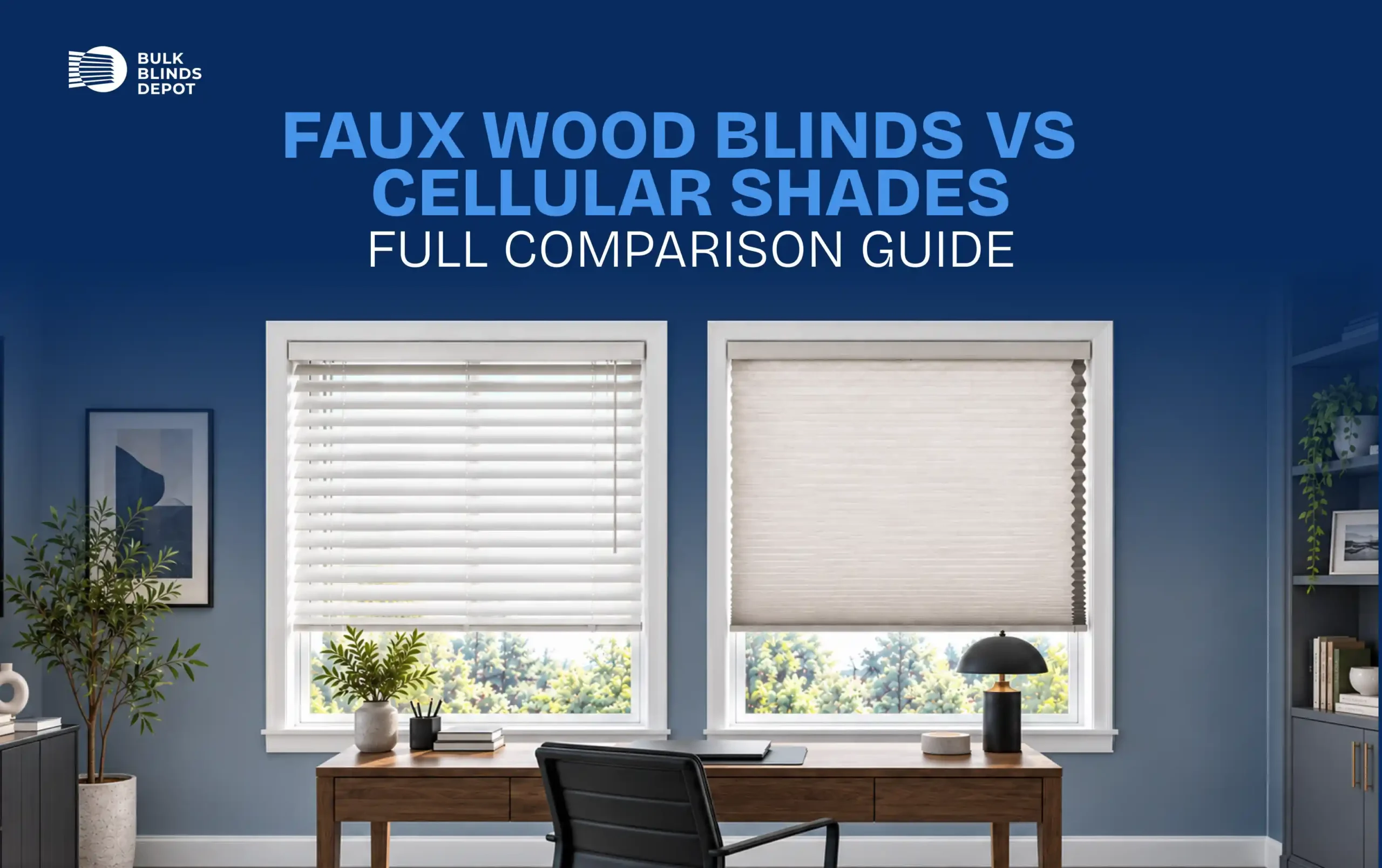
Faux Wood Blinds vs Cellular Shades: Which is Better?
TL:DR
Faux wood blinds and cellular shades each suit different needs. Faux wood blinds are best for adjustable light control, moisture resistance, durability, and easy cleaning, making them ideal for kitchens, bathrooms, and busy spaces. Cellular shades are better for insulation, energy efficiency, privacy, and room darkening, especially in bedrooms and living rooms. Both offer attractive designs and strong privacy. The best choice depends on your room, climate, maintenance needs, and style preferences, you can use different treatments in different rooms.
There is no universal winner between faux wood blinds and cellular shades. And this blog is definitely not focused on debating and battling faux wood blinds with cellular shades to decide which is better. Both are best at what they do and provide.
But the question is you can’t put both blinds on one window right? Therefore to get the right one you need answers to your concerns first. This blog will provide a detailed comparison of faux wood blinds and cellular shades and help you decide which blind is best for your specific needs.
Faux Wood Blinds vs Cellular Shades at a Glance
Faux wood blinds and cellular shades are better at handling light, ensuring privacy and giving a clean look. But there are still some minute details and needs that qualify cellular or faux wood as a single option to go for your room. Below is a quick comparison providing you with which shade is better in various aspects.
| Feature | Faux Wood Blinds | Cellular Shades |
| Style | Classic, structured wood look | Soft, clean, modern look |
| Light Control | Excellent with adjustable slats | Good, depends on fabric type |
| Privacy | Excellent | Excellent |
| Insulation | Moderate | Excellent |
| Energy Efficiency | Moderate | Excellent |
| Moisture Resistance | Excellent | Moderate |
| Cleaning | Easy to wipe clean | Requires gentler cleaning |
| Best For | Kitchens, bathrooms, offices, high-traffic rooms | Bedrooms, living rooms, energy-efficient spaces |
| Motorization | Available for tilt and, on some models, lift | Available for raising and lowering |
Best for insulation: Cellular shades
Best for precise daylight control: Faux wood blinds
Best for humid/easy-clean environments: Faux wood blinds
Best for blackout configurations: Cellular shades
So what’s best overall? It completely depends on your room, its direction, its occupied space and your own personal needs.
Understanding Both Window Treatments First
What are Faux Wood Blinds?
Faux wood blinds are artificial versions of real wooden blinds made with PVC, vinyl or other composite materials that offer better moisture control and easier ways to maintain.
What are Cellular Shades?
Cellular shades are window coverings made of fabric with a honeycomb structure that traps air, providing better insulation through its honeycomb cells while offering better light control and privacy.
Faux Wood Blinds vs Cellular Shades: 7 Key Differences You Should Know
1. Light Control and Room Darkening
Faux wood blinds offer flexible light control as the slats can be tilted to redirect the sun’s rays without opening the blinds. But there are small gaps that do not allow complete blackout. Cellular shades regulate light primarily by means of the fabric’s opacity. Light-filtering fabrics diffuse daylight, and blackout fabrics are more effective at darkening a room, but may have small gaps around the edges.
Verdict: Faux wood for adjustable daylight and cellular shades for more room-darkening.
2. Privacy
Faux wood blinds can be used to create privacy with the ability to move the slats to let in some light and block out the view. Cellular shades offer decent privacy when closed, but the degree of privacy may vary based on the fabric used. Fabrics that filter light can offer shadows, and blackout fabrics offer more privacy and visual separation.
Verdict: Depends on your preference for privacy vs daylight.
3. Energy Efficiency and Insulation
The advantage of cellular shades is that they are very good insulators because the honeycomb-shaped cells trap air between the window and the room, providing an extra layer of insulation. While faux wood blinds can block direct sunlight when closed, they do not insulate. This is why cellular shades are especially useful in environments where minimizing heat transfer and enhancing comfort inside the home are important.
Verdict: Cellular shades are a better option when it specially comes to saving energy and insulation.
4. Moisture and Humidity Resistance
Faux wood blinds are typically more suitable for humid or splash prone spaces, as PVC, vinyl and composite materials tend to be more moisture resistant than many fabric treatments. This makes them an ideal option for kitchens and bathrooms. Fabric shades, like cellular shades, will vary in moisture resistance depending on the product and fabric, and may not be the best choice if humidity is a concern for long periods of time.
Verdict: Faux wood blinds are considerably better options in frequently moist areas.
5. Cleaning, Maintenance and Durability
Faux wood blinds can typically be dusted with a damp cloth on individual slats, but horizontal surfaces can gather dust. They are also very sturdy and work great in areas that are used often. Usually, cellular shades need light dusting or vacuuming, and stains may be more difficult to clean on fabric. They may also be more delicate to use due to their pleated design.
Verdict: Faux wood blinds are a better option for easier maintenance.
6. Appearance and Style Fit
Faux wood blinds add a sense of structure and architecture and have a strong horizontal line, as well as a classic or transitional style like wood blinds. Cellular shades are softer in appearance and have a more streamlined design, with a subtle pleated texture that is suitable for modern interior design. Cellular shades also stack up into a relatively small profile when lifted, keeping the window’s profile cleaner.
Verdict: It completely depends on your taste and personal preference.
7. Cost and Long-Term Value
The price of both treatments can differ significantly depending on window size, window material, and operating system. Double-cell construction, blackout fabrics, top down/bottom up and motorization can all lead to higher cellular shade prices. The price of faux wood blinds may differ depending on the quality of the slats, custom sizing, cordless controls, and commercial specifications. Long-term value is more about the needs of the room than the price.
The verdict is: Don’t just look at the initial price, look at features and usage and then make a decision especially when you are planning on getting blinds in bulk.
How to Choose Between Faux Wood Blinds or Cellular Shades
These blind choices really come down to what matters most in each room.
Choose faux wood blinds:
If you want more control over daylight throughout the day. The adjustable slats make it easy to manage glare and privacy without fully opening the window. They are also a practical option for kitchens, bathrooms, and other busy spaces because they are easy to wipe clean, durable, and often better suited to moisture and humidity. Their structured look also works well if you prefer a more classic window style.
Choose cellular shades:
If insulation and energy efficiency are higher priorities. Their honeycomb construction helps reduce heat transfer, while light-filtering fabrics create softer daylight. Blackout options also make them a strong choice for bedrooms, and their compact stack and clean design suit more minimal interiors.
You also do not need to choose one style for the entire home. If it solely comes to debate of faux wood blinds vs honeycomb shades then honeycomb(cellular) shades may work better in bedrooms, faux wood blinds in bathrooms, and either option can suit living rooms depending on your light, and design preferences.
Closing Words
To conclude, faux wood blinds and cellular shades are few of the best window treatment solutions that provide outstanding light blocking facility and upholds sleek and structured presence that adheres to any modern interior space. Before buying either you need to analyze each blind strongest area and then decide on choosing them for your room.
FAQs
Are cellular shades better than faux wood blinds?
Not necessarily. When comparing cellular shades vs faux wood blinds, the better option depends on your priorities. Cellular shades are generally better for insulation, energy efficiency, and a softer look, while faux wood blinds are better for adjustable light control, moisture resistance, and easy cleaning.
Which is more energy efficient, faux wood blinds or cellular shades?
Cellular shades are more energy efficient because their honeycomb-shaped cells trap air near the window and help reduce heat transfer. In the faux wood blinds vs cellular shades comparison, cellular shades are the stronger choice when insulation and indoor temperature control are the main priorities.
Which gives better privacy, cellular shades or faux wood blinds?
Both provide good privacy, but in different ways. Faux wood blinds let you adjust the slat angle to balance privacy with natural light, while cellular shades provide strong privacy when fully lowered. Blackout cellular shades generally offer the highest level of privacy.
Do cellular shades block more light than faux wood blinds?
Yes, blackout cellular shades can block more light than faux wood blinds. Faux wood blinds have small gaps between the slats and around the edges, so some light can still enter. Cellular shades with blackout fabric provide stronger room darkening, although small installation gaps may remain.
Which is easier to clean, faux wood blinds or cellular shades?
Faux wood blinds are generally easier to clean because their slats can be wiped with a cloth or lightly dusted. Cellular shades require gentler cleaning, such as vacuuming with a brush attachment. For busy areas where easy maintenance matters, faux wood blinds are usually the more practical choice.
Which lasts longer: faux wood blinds or cellular shades?
Faux wood blinds often have an advantage in high-use or humid spaces because their rigid materials are designed to handle regular use and moisture. Cellular shades can also last for years with proper care, but their fabric and pleated construction require more careful handling. So, are cellular shades better than faux wood blinds? For durability alone, faux wood usually has the edge.
Are faux wood blinds better for bathrooms? Yes. Faux wood blinds are the better choice for bathrooms since they resist the humidity, steam, and moisture that can cause real wood to warp, crack, or develop mold over time. Their wipe-clean surface also makes them easier to maintain in a room that sees regular condensation and splashes.
Follow Us:



Kevin Salazar
Founder & Window Treatment Specialist
Kevin is a window treatment specialist with extensive experience in commercial offices, government facilities, schools, and homes. From solar shades to blackout roller shades, he’s helped hundreds of clients choose, measure, and install the right products for their space. He is the founder of Bulk Blinds Depot; his mission is simple: to make buying window treatments easy and efficient at hard-to-beat prices.