516-212-2002



October 15, 2026
How to Find the Best Blinds For Sliding Glass Doors
TL;DR
There’s no single best blind for every sliding glass door, the right choice depends on how often the door is used, how wide it is, how the treatment opens, and how much privacy, light control, and insulation you need. The Quick “best for” guide is: Vertical Blinds for frequent access, Panel Track Blinds for wide modern openings, Solar Shades for glare control, Roller Shades for a clean minimal look, and Cellular Shades when insulation is the priority. Vertically lifting shades (roller, solar, cellular) can work well on sliding doors too. They’re just less convenient on doors opened constantly, since the shade typically needs to be raised before passage.
Sliding glass doors are one of the trickiest windows in the house to shop for and the reason isn’t the door itself, it’s everything that comes with it. Standard blind sizes rarely stretch wide enough to cover them, foot traffic means whatever you choose is getting brushed against, bumped, and walked through constantly, and most people don’t realize how many blind types simply weren’t built to handle a door that opens and closes. Finding the best blinds for sliding glass doors means solving for all of that at once, not just picking whatever looks good in the display photo.
If you’ve already been down this road, you know the frustration: vertical blinds that clatter every time the door opens, horizontal blinds too narrow to cover the full span without ordering a custom size, or panel tracks that look sleek in pictures but leave you wondering if they’ll actually hold up to daily use from kids, pets, or a busy household.
In this guide, we’ll break down the best blind options specifically built for sliding glass doors, what to look for based on your household’s traffic and light needs, and how to avoid the common sizing and durability mistakes that come with this trickier window type.
What Makes Blinds Suitable for Sliding Glass Doors?
Before recommending specific products, it helps to understand what makes blinds for a sliding glass door work, since the criteria differ from those for a standard window.
Operation Direction
How a blind opens matters here, since it needs to work around a door people walk through. Side-to-side treatments like vertical blinds or panel tracks often suit sliding doors well, since they move in the same direction as the door and clear the doorway without lifting the entire covering.
Door-Access Frequency
A door used constantly benefits from a treatment that quickly clears the doorway. A less-frequently-used door has more flexibility either way.
Width
Sliding doors are almost always wider than standard windows, so look for products designed to scale to wider spans, or plan for a custom order.
Stack Space and Clearance
Check how much space a blind takes up once opened, whether stacked to the side or lifted up so it doesn’t block part of the doorway even when fully open.
Privacy
Sliding doors often face patios or backyards, so privacy needs can be higher, especially in the evening when interior lights make a room visible from outside.
Light Control
Sliding doors typically let in more direct light than a standard window, so adjustable light control matters more for comfort and glare management.
Insulation
Given their size, sliding doors can be a bigger source of heat gain or loss, so insulating performance is worth considering, especially for sun-facing doors.
A Note on Vertically Lifting Shades
Vertically lifting shades aren’t automatically a poor fit for sliding doors. It depends on how often the door is used and how the shade is configured, a shade split into two panels, for example, can work well even on a high-traffic door.
Best Blinds for Sliding Glass Doors By Comparison
| Blind Type | Best Use | Operation | Suitability for Large Doors | Light/Privacy Strength | Main Limitation |
| Vertical Blinds | Frequent door access | Side-to-side, rotating vanes | Strong, built for wide openings | Adjustable via vane rotation | Traditional look may not suit every interior |
| Panel Track Blinds | Wide, modern openings | Panels glide and stack to the side | Strong, designed for broad spans | Depends on fabric choice | Requires adequate stack-back space |
| Solar Shades | Glare and solar control | Vertical lift | Moderate, width limits vary by product | Good glare/UV control, limited nighttime privacy | Not ideal for heavily used doors |
| Roller Shades | Clean, minimal look | Vertical lift | Moderate, width limits vary by product | Flexible depending on fabric | Must be raised before walking through |
| Cellular Shades | Insulation priority | Vertical lift (standard) | Moderate, depends on configuration | Strong insulation, privacy varies by opacity | Vertical lift versions less convenient for frequent access |
1. Vertical Blinds – Best for Frequent Door Access
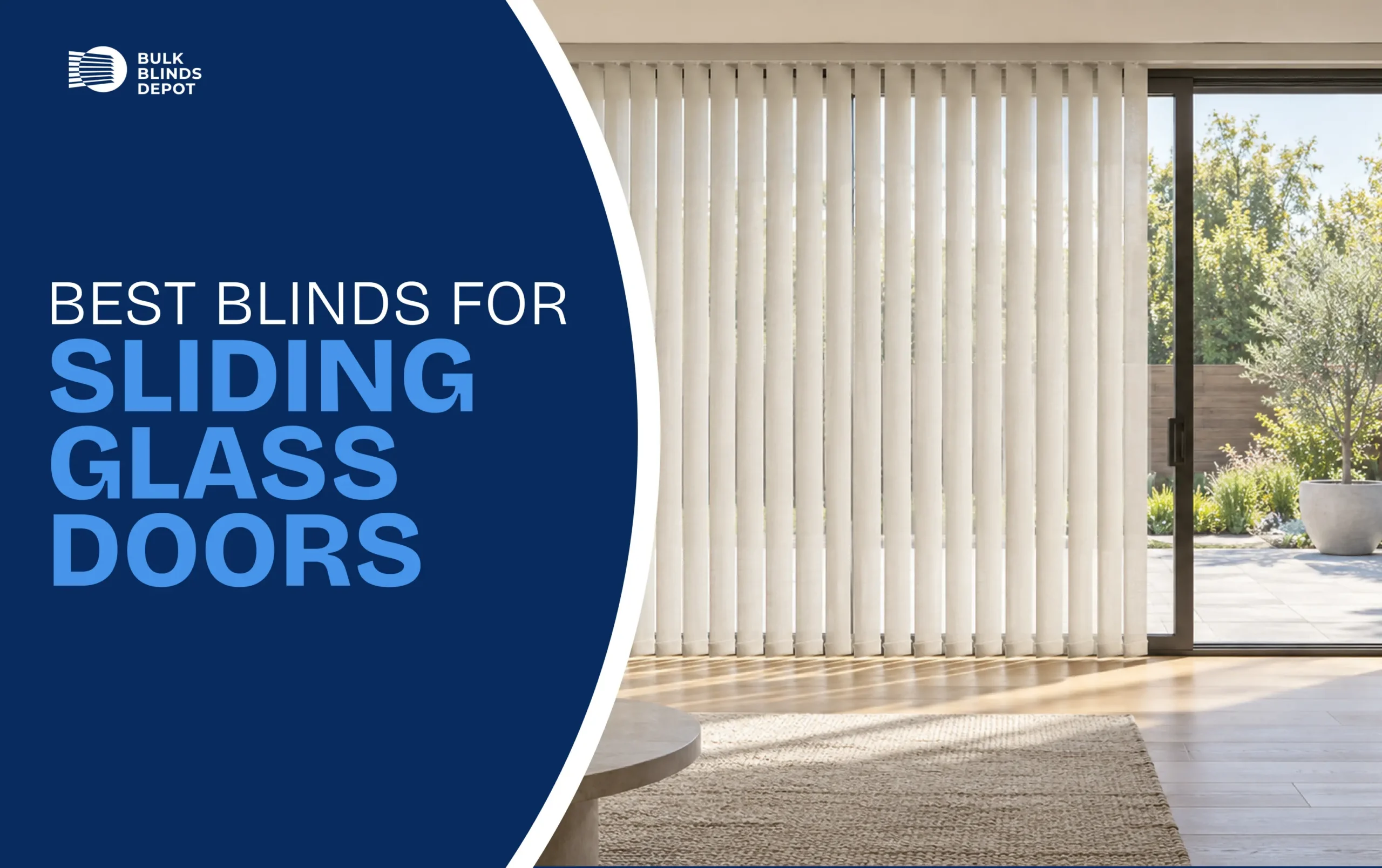
Vertical blinds are particularly well suited to sliding doors, using rotating vanes that hang from a side-to-side track. Since the vanes rotate in place, you get adjustable light and privacy without needing to raise or lower anything, and the panels stack neatly to one side, making everyday access to the door quick and easy. Vinyl vertical blinds are a common material choice within this category, the operating system stays the same, but vinyl adds moisture resistance and easy wipe-down maintenance, making it a practical option for sliding doors near kitchens, patios, or high-humidity spaces.
2. Panel Track Blinds – Best for Wide, Modern Openings
Panel track blinds use broad fabric panels that glide along a track and stack to one side, similar in concept to vertical blinds but with a cleaner, more contemporary look. This makes them a strong fit for wide sliding doors, especially in modern interiors where the wider fabric panels read as more polished than traditional vertical vanes. Privacy and light control depend heavily on the fabric chosen, ranging from sheer to blackout. Since the panels stack to the side when open, make sure there’s enough wall space available for them to fully clear the doorway.
3. Solar Shades – Best for Glare and Solar Control
Solar shades are a strong option for sliding doors that get significant direct sunlight, since their tightly woven fabric reduces glare and UV exposure while often preserving some view through the fabric, depending on its openness or transparency rating. It’s worth noting that solar shades don’t provide complete nighttime privacy because the fabric is designed to be seen through, visibility increases once it’s dark outside and lights are on indoors. Since these operate as a vertical lift, they may also be less convenient on a heavily used doorway, where raising the shade every time someone walks through can become repetitive.
4. Roller Shades – Best for a Clean, Minimal Look
Roller shades offer a simple roll-up operation and a wide range of fabric choices, giving flexible control over both light and privacy depending on the opacity selected. The main trade-off on a sliding door is access, since the shade lifts vertically, it typically needs to be raised before someone can walk through. This becomes less of an issue if the door isn’t used frequently, or if the shade is configured as two independent sections so only one side needs to be raised for daily access.
5. Cellular Shades – Best When Insulation Is the Priority
Cellular shades use a honeycomb-shaped construction that traps air for genuine thermal insulation, making them a strong choice when energy efficiency is the priority for a large sliding door. They also offer a range of light-filtering to room-darkening opacity options depending on privacy needs. Most cellular shades raise vertically, similar to roller shades, so the same access consideration applies on frequently used doors. Vertical cellular systems that move side-to-side also exist as a separate configuration, though availability varies by manufacturer, check current product offerings to confirm which configuration is in stock.
Vertical Blinds vs Panel Track Blinds for Sliding Glass Doors
Both vertical blinds and panel track blinds are strong side-drawing options for sliding doors, but they differ in a few key ways.
| Consideration | Vertical Blinds | Panel Track Blinds |
| Operation | Rotating vanes on a side-to-side track | Broad flat panels that glide along a track |
| Light Adjustment | Vanes rotate for fine-tuned control | Depends on fabric choice, not adjustable in place |
| Appearance | More traditional, segmented look | Cleaner, more contemporary look with fewer visible lines |
| Suitability for Large Openings | Strong and built for wide spans | Strong and designed for broad, modern openings |
| Stack Behavior | Vanes stack compactly to one side | Panels stack to one side, but need more stack-back space |
Demand for vertical and panel track blinds is best suited to wide sliding and patio doors, and is projected to grow at a CAGR of 4.5% to 6.5% through the early 2030s, largely driven by modern homes favoring floor-to-ceiling glass.
What Blinds Should You Avoid on a Sliding Glass Door?
It’s less about specific sliding glass door blinds being “wrong” and more about certain setups causing everyday friction. Here’s what to watch out for.
A Single, Full-Width Horizontal Blind
Covering an entire sliding door with one large horizontal blind can create a real usability problem. Since the whole covering needs to be raised before anyone can walk through, this becomes cumbersome fast on a wide opening, especially one that’s used multiple times a day.
One-Piece Vertically Lifting Treatments on High-Traffic Doors
Roller, Roman, and standard cellular shades aren’t off-limits for sliding doors, they can absolutely work well, especially on doors that aren’t opened constantly. The issue is convenience: a single vertically lifting shade that has to be raised every time someone walks through can get repetitive quickly on a door used often throughout the day. Splitting the shade into two independent sections, or reserving these styles for less-frequently-used doors, avoids the problem entirely.
In most cases, vertical blinds for sliding glass doors sidestep this issue altogether, since they clear the opening without needing to be raised.
Poor Clearance and Mounting
Even a well-suited blind can become frustrating if clearance isn’t accounted for. Mounting too close to the door handle, insufficient stack-back space for panels or vanes to fully clear the opening, or brackets positioned where they interfere with the door’s track can all turn an otherwise good choice into a daily annoyance. Checking clearance before installing is just as important as picking the right blind type.
Things To Consider In Blinds For Large Sliding Glass Doors
Choosing blinds for large sliding doors takes a bit more planning than a standard window, since a wider opening leaves less room for guesswork. Run through this checklist before deciding:
- Full opening width: Measure the entire span you need covered, not just the glass panel, since some treatments need to extend beyond the frame for full coverage.
- Which panel is the active door: Identify which side actually slides open, since your blind configuration should let that section clear easily without disturbing the rest of the covering.
- Available stack-back space: Check how much wall or frame space is available for panels, vanes, or a shade to stack into once opened, so nothing ends up blocking the doorway.
- Privacy needs: Consider how visible the door is from outside, especially in the evening, and how much privacy the space realistically needs.
- Glare and view priorities: Decide whether preserving the outdoor view matters as much as controlling sunlight and glare.
- Frequency of use: A door used constantly benefits from a side-to-side or split configuration; a less-used door has more flexibility.
- Maintenance: Factor in how easy the material is to clean, especially near a door that sees more dust, handprints, and foot traffic than a typical window.
- Whether an outside mount may be needed: If the door frame doesn’t offer enough depth or width for an inside mount, an outside mount may be the more practical option for full coverage.
Choosing the Right Blinds for Your Sliding Glass Door
At the end of the day, the right blind for a sliding glass door comes down to how the door actually gets used, not just which style looks best in a showroom photo.
- Choose Vertical Blinds if the door is accessed frequently each day.
- Choose Panel Track Blinds for a very wide, modern opening where a cleaner look matters.
- Choose Solar Shades if glare and sun exposure are the main concern.
- Choose Roller Shades for a minimal, streamlined style, especially on doors that aren’t used constantly.
- Choose Cellular Shades when insulation and energy efficiency are the top priority.
Whatever you’re drawn to visually, it’s worth thinking through door operation and everyday access first, a blind that looks perfect but gets in the way every time the door opens will end up being more of a hassle than a highlight in the long run.
Conclusion
Choosing blinds for a sliding glass door really comes down to one question: how does this door actually get used day to day? Once that’s clear, everything else, such as width, stack-back space, privacy, light control, and insulation, falls into place around it. A high-traffic patio door calls for something that clears the way quickly, while a rarely-used door or one facing strong sun leaves room to prioritize insulation or glare control instead.
Browse our blind collections to compare options against your door’s width and specs, or reach out to our team for help with large or multi-door projects.
Frequently Asked Questions
1-What are the best blinds for a sliding patio door?
Patio door blinds that draw side-to-side, like vertical blinds or panel track blinds, tend to work best since they clear the doorway without needing to be raised. The right choice ultimately depends on how often the door is used, how much privacy is needed, and whether a traditional or modern look fits the space better.
2-What is the best type of window covering for sliding glass doors?
There’s no single best window treatment for sliding glass doors, it depends on priorities like access frequency, width, and light control. Vertical blinds and panel track blinds suit frequently used doors well, while solar, roller, or cellular shades work better on doors used less often or where insulation and light control matter more.
3-What are alternatives to vertical blinds for sliding glass doors?
Panel track blinds are the closest alternative, offering the same side-to-side operation with a cleaner, more contemporary look. Solar shades, roller shades, and cellular shades are also options, though these lift vertically rather than sliding to the side, making them better suited to doors that aren’t opened as frequently.
4-Are roller shades good for sliding glass doors?
Yes, roller shades can work well on sliding glass doors, especially for a clean, minimal look. Since they lift vertically, they’re most convenient on doors that aren’t used constantly, or when configured as two independent sections so one side can stay lowered while the other opens for access.
5-Are cellular shades good for sliding glass doors?
Yes, particularly when insulation is a priority, since their honeycomb construction traps air for genuine thermal benefits. Like roller shades, standard cellular shades lift vertically, so they suit doors with less frequent use best, though vertical cellular configurations are available in some product lines.
6-What blinds work best for very large sliding glass doors?
Vertical blinds and panel track blinds tend to work best for large sliding doors, since both are designed to scale across wide openings while stacking neatly to one side. Checking available stack-back space and full opening width beforehand helps ensure the chosen treatment fits comfortably once installed.
Follow Us:



Kevin Salazar
Founder & Window Treatment Specialist
Kevin is a window treatment specialist with extensive experience in commercial offices, government facilities, schools, and homes. From solar shades to blackout roller shades, he’s helped hundreds of clients choose, measure, and install the right products for their space. He is the founder of Bulk Blinds Depot; his mission is simple: to make buying window treatments easy and efficient at hard-to-beat prices.