516-212-2002



October 19, 2026
Solar Shades vs Blackout Shades: Which Should You Choose?
TLDR:
Solar shades vs blackout shades comes down to which problem you’re solving. Solar shades filter daylight, cut glare, and preserve your view, making them ideal for living rooms, home offices, and sun-facing windows, but they don’t offer reliable nighttime privacy. Blackout shades block light entirely, giving strong privacy and darkness day and night, best suited to bedrooms, nurseries, and media rooms. If a room needs both, the two can be layered together on the same window.
Picture two rooms in the same house: one bright and airy all day, the other pitch black at 2 p.m. with the curtains drawn. Both homeowners are happy with their windows, they just solved completely different problems. That’s the real story behind solar shades vs blackout shades: it’s not a question of which one is better, but which problem you’re actually trying to solve.
Maybe you’re tired of squinting at your TV or laptop screen every afternoon when the sun hits just right. Or maybe you’re a shift worker, new parent, or light sleeper who needs a bedroom that stays dark no matter what time the sun comes up. Solar shades and blackout shades both block light, but they do it in almost opposite ways, one preserves your view and lets diffused daylight in, the other shuts it out completely.
In this guide, we’ll break down exactly how solar shades and blackout shades compare, so you can figure out which one actually fits the room and the problem you’re solving for.
Blackout vs Solar Shades at a Glance
Before diving into the details, here’s how the two compare across the factors that matter most when choosing between them.
| Consideration | Solar Shades | Blackout Shades |
| Light Control | Filters and softens daylight rather than blocking it | Blocks light almost entirely, keeping rooms dark even during the day |
| Daytime Privacy | Moderate, fabric openness allows some visibility through | Strong, opaque fabric prevents outside visibility |
| Nighttime Privacy | Limited, see-through fabric means visibility increases once interior lights are on | Strong, maintains privacy regardless of time of day |
| View Preservation | Strong, most fabrics let you see outside while filtering glare | None, fully opaque fabric blocks the view entirely |
| Glare & UV Control | Reduces glare and filters UV exposure, depending on fabric openness | Blocks light and glare completely, but isn’t chosen specifically for glare filtering |
| Best Rooms | Living rooms, home offices, sun-facing windows | Bedrooms, media rooms, nurseries |
| Noise/Insulation | Varies by fabric and manufacturer, check product specs for verified performance | Varies by fabric and manufacturer, check product specs for verified performance |
What Are Solar Shades?
Solar shades are roller-style shades made from a screen-like solar fabric that filters light rather than fully blocking it. Most of the performance comes down to the fabric’s openness factor, a lower openness factor filters more light and reduces visibility through the fabric, while a higher openness factor lets in more daylight and preserves a clearer outdoor view.
Solar shades hold 60% of the sustainable window treatment segment
Their main strengths: reduced glare, filtered UV exposure, and a bright room that still keeps a view outside. The key limitation: solar shades aren’t a dependable nighttime-privacy solution, since the same see-through fabric that preserves your view during the day increases visibility from outside once interior lights are on after dark.
What Are Blackout Shades?
Blackout shades are roller shades made from opaque blackout fabric, built specifically for strong light blocking and room darkening. Unlike solar fabric, there’s no openness factor, the material is designed to prevent light from passing through entirely.
Blackout shades are the most purchased product for bedrooms (55% of total sales)
Their main strengths: real darkness, strong privacy day or night, and fewer visual distractions making it a strong fit for bedrooms, nurseries, or media rooms. One clarification worth noting is that blackout fabric doesn’t guarantee zero visible light in every installation, since side gaps or certain mounting conditions can still let some light through the edges. The trade-off is that when lowered, blackout shades remove the outside view and natural daylight entirely.
Key Differences Between Solar and Blackout Shades
1-Light Control and Room Darkening
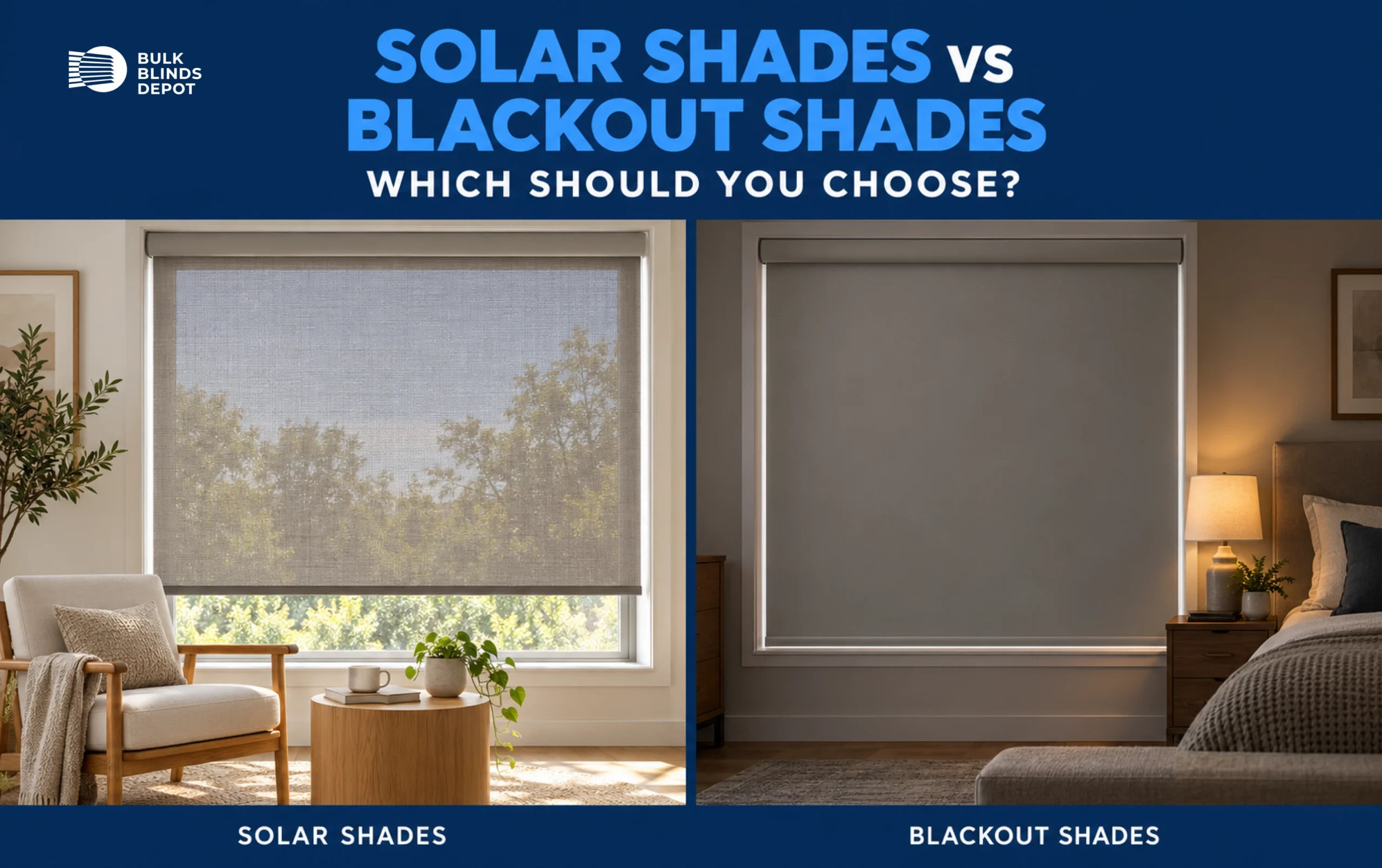
The core difference comes down to what each fabric is designed to do with light. Solar shades soften and filter incoming light, taking the edge off harsh sun while still letting daylight into the room. Blackout shades do the opposite by design, they’re built to darken a room as fully as possible, blocking light rather than diffusing it. Neither one controls light “better” in a general sense, the right answer depends on whether you want a softly lit room or a genuinely dark one.
2-Privacy (Especially at Night)
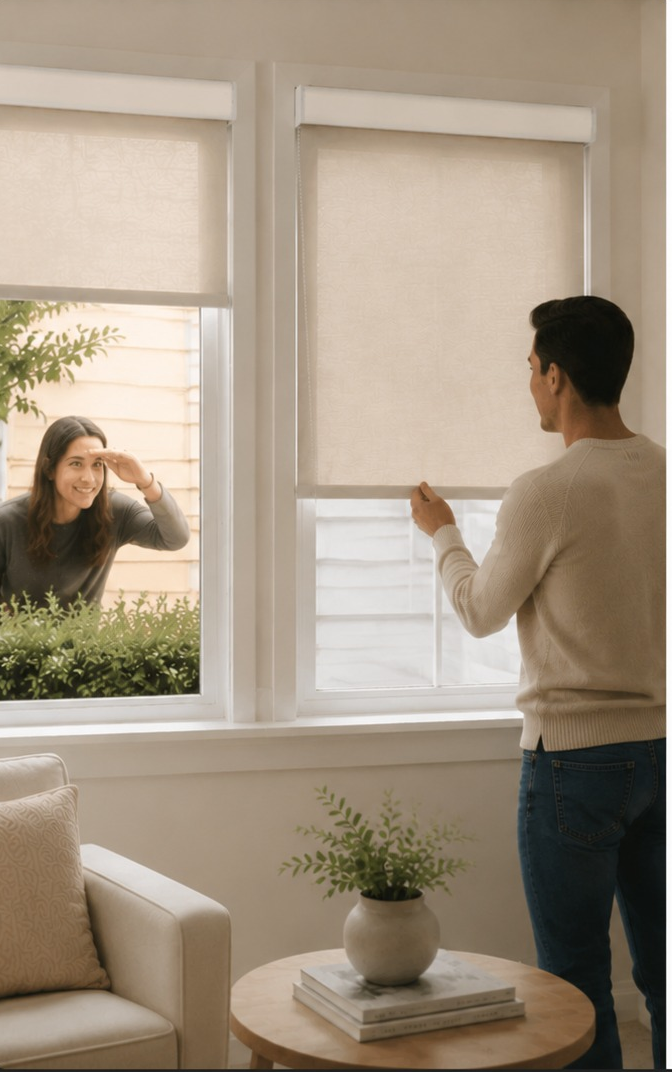
This is often the deciding factor, and it’s worth understanding clearly. During the day, solar shades can offer useful screening, since the fabric’s openness reduces visibility from outside while still letting you see out. At night, though, this can reverse: once the room is brighter than the outdoors, the same fabric that provided daytime privacy can make the interior more visible to anyone outside. If privacy matters both day and night, a bedroom, a street-facing room, or a space near neighbors, blackout shades are the stronger choice, since their opaque fabric doesn’t depend on outdoor light levels to work.
3-Outdoor View, Glare and UV Exposure
Solar shades are the better fit when preserving a view and cutting glare are priorities, since the fabric is specifically designed to filter sunlight while remaining at least partially see-through. They also help reduce UV exposure to the room, though the exact degree depends on the fabric’s specific weave and openness factor. Blackout shades remove the outdoor view entirely when lowered, since blocking light is the point, there’s no partial-visibility option the way there is with solar fabric.
4-Heat Gain and Comfort
Both shade types can help manage solar exposure, just in different ways. Solar shades work by filtering direct sunlight before it enters the room, reducing glare and heat buildup while still allowing daylight through, a good fit for sun-facing rooms used throughout the day.
Blackout shades for windows manage heat and comfort differently, relying on their opaque coverage to block sunlight and heat from entering a space altogether, which suits rooms where full room-darkening is already the goal, like bedrooms or media rooms. Exact energy performance varies by fabric and manufacturer, so it’s worth checking specific product data if energy savings are a priority.
What Homeowners Are Saying Among Community Groups
Beyond solar roller shades vs blackout roller shades comparisons, real homeowners have been working through this exact decision on forums like Houzz for years, and their firsthand experience adds a few practical details worth knowing.
In one Houzz discussion on black solar shades, a homeowner with solar shades installed on all south-facing windows of a three-story house confirmed what manufacturers say about nighttime privacy: the shades don’t provide any once it’s dark. They noted the shades did a lot to control glare and heat through summer, though they still needed drapes in addition during early spring and late fall when the sun angle changed. Another commenter in the same thread mentioned that some solar shade products now come with a built-in blackout layer that can be used together or separately, avoiding the need for a completely separate treatment.
A separate Houzz thread on choosing shades echoed the same pattern from someone who works with these products regularly: they described mixing solar shades with drapes specifically in rooms where nighttime privacy mattered, while reserving solar shades alone for spaces used mainly during the day. They also mentioned a personal preference for darker solar fabric in the 10% openness range, noting that darker colors tend to preserve a clearer daytime view.
Which Shade Is Better for Each Room?
- Living room / family room: Solar shades work well when preserving the view, daylight, and glare control matter most. Choose blackout instead if strong privacy or darkening is the bigger priority for that space.
- Bedroom / nursery: Blackout shades usually fit the goal better, since darkness and privacy typically outweigh the need to maintain a view.
- Home office: Solar shades are usually the better starting point, cutting screen glare while keeping the room bright. Blackout can help in cases where total light control is needed instead.
- Media room / home theater: Blackout shades are the clear fit, since full room darkening is the point.
- Kitchen / sunroom: Solar shades tend to work best, where brightness, glare control, and outward visibility add the most value.
Can You Use Solar and Blackout Shades Together?
Yes, for windows where the setup allows it, pairing a solar shade with a blackout shade is a practical way to get both benefits rather than choosing one over the other. This typically works through a layered or dual-shade configuration, where each shade operates independently on the same window.
The common use case: run the solar layer during the day for glare control and an outdoor view, then lower the blackout layer at night (or whenever full privacy or darkness is needed) without giving up the daytime benefits the rest of the time. This setup is especially useful in bedrooms or living spaces that serve double duty, bright and open during the day, fully private and dark at night.
Availability of a combined or dual-shade system varies by product and manufacturer, so it’s worth checking current offerings to see what configurations are available for your specific window.
Solar Shades or Blackout Shades: How to Choose
At this point, the decision comes down to matching the shade to what the room actually needs day-to-day.
- Choose solar shades if your priorities are filtered daylight, glare control, maintaining a view, and a brighter daytime room.
- Choose blackout shades if your priorities are sleep, room darkening, nighttime privacy, or media viewing.
- Consider both if the same room needs daytime openness and nighttime darkness or privacy, a layered or dual-shade setup lets you get each benefit without compromising on the other.
There’s no universal winner between the two, since they’re built to solve different problems. The right pick simply depends on which one matches what you actually need from that room.
To Summarize
At the end of the day, the solar shades vs blackout shades decision comes down to one core trade-off: solar shades give you filtered light, glare control, and a preserved view, while blackout shades give you real darkness and privacy, day or night. Neither one is objectively better, they’re built to solve different problems, and the right pick depends entirely on which of those outcomes matters most for the room in question. A sunny living room or home office usually leans toward solar, a bedroom or media room usually leans toward blackout, and any space that needs both at different times of day is a good candidate for layering the two together.
Browse Bulk Blinds solar and blackout shade collections to compare fabric and openness options, or reach out for help with larger or commercial projects.
Frequently Asked Questions
What are the downsides of using solar shades?
The main downside is limited nighttime privacy, since the fabric is designed to be seen through and becomes more visible from outside once interior lights are on. This is one of the biggest factors people weigh when deciding between solar shades or blackout shades, since solar shades also don’t provide full room darkening.
Do solar shades provide privacy at night?
Not reliably. Solar shades offer decent daytime privacy since exterior light is stronger than interior light, but this reverses after dark, once lights are on inside, visibility from outside increases. This is one of the biggest factors people consider when deciding between solar and blackout shades.
Are blackout shades better for bedrooms?
Yes, in most cases. Blackout shades block nearly all incoming light and maintain full privacy day and night, making them a strong fit for bedrooms where sleep quality and privacy matter more than preserving a view.
Can solar shades and blackout shades be used on the same window?
Yes, many setups allow both to be layered on the same window using a dual-shade configuration. This lets you run the solar layer during the day for light and view, then lower the blackout layer at night for full darkness and privacy.
Follow Us:



Kevin Salazar
Founder & Window Treatment Specialist
Kevin is a window treatment specialist with extensive experience in commercial offices, government facilities, schools, and homes. From solar shades to blackout roller shades, he’s helped hundreds of clients choose, measure, and install the right products for their space. He is the founder of Bulk Blinds Depot; his mission is simple: to make buying window treatments easy and efficient at hard-to-beat prices.